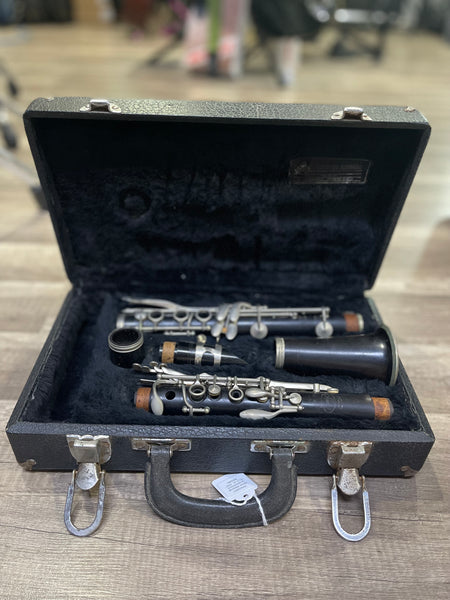
Selmer Signet 100 "Special"

As I have my wife's vehicle today (my car repair is still in process), I am happily still going to be able to go to the Retiree's Cigar Group this afternoon!! I am very much looking forward to talking with the fellows. It is such a fun, jovial group and I am so happy I tried it out.... and that I feel I fit in very well!
"Bore Oil" is a fluid that is well know to most clarinetists. If you are fortunate enough to have a horn that is made of grenadilla wood (in olden days, the body of less expensive horns were made from metal or galvanized rubber and did not use bore oil.... and today, less expensive horns are made of plastic and also do not use bore oil), you need to regularly oil the wood with bore oil to prevent cracking/splitting of the wooden body parts.... which can happen EASILY in a grenadilla wood clarinet due to it continually experiencing drying (when not playing) and moisture (while playing). Grenadilla wood is a very dark wood and gives the clarinet its classic, nearly black color.
When I was evaluated for my horn back in 5th Grade, I ultimately chose the clarinet (see previous post a couple of days ago for more details if desired). The music store fellow who assigned to us which horns we would get, had a big box of Selmer Signet 100 clarinets.... which were decent, student-level horns of that era.... and the plus was that unlike the "inexpensive" horns the music store fellow did not immediately offer (he only did to so, behind the scenes to parents who balked at the purchase) , the Selmer Signet 100 horns were made of actual grenadilla wood. So that is what my parents got for me.... they were not ones to "question" the authority of the music store fellow.
So, I and 5 or so other of my friends who were designated future "clarinetists" got these particular horns. Some of us were rather fastidious (including me) and took to heart the idea of "oiling" our clarinets regularly. A couple of my friends, though... were not particularly fastidious by nature... and did not do so. After about two-three years, a couple of these friends had a problematic crack or two or three develop in their horn.
One thing I noticed on my horn that none of my clarinet peers had, was that along with the normal "Selmer Signet 100" stamped into each section of the horn, I had stamped in mine the additional word, "Special". I thought this was rather cool, although I really had no idea why it was there. I did not really talk about it much but I did like that it was stamped in there.
It was not until many decades later, with the age of the Internet, that I thought about investigating my horn more. I was very surprised to learn that my "Special" designation to my Selmer Signet 100 indicated that it was NOT just a nice, student-level horn, but instead was considered an "Intermediate-level" horn (not a "Professional" horn, but in-between student and professional). I confirmed this was true also by reading on the Internet the stamping numbering system used on the mouthpieces. Student-level mouthpieces had one particular stamping number, but the "Special" had a different stamping indicating a slightly better mouthpiece as well..... which conformed to what I had as well!
I was very surprised.... happily. My parents had bought what was offered by the music store fellow, and did not question it. And, the horn did not differ in price from what the other kid's parents bought either.
In thinking about and contemplating this realization that I had what was classified an "Intermediate-level" horn.... it helped me to make sense of a couple of things that I had noticed and had aggravated me a bit back as a 5th grader:
1. Even though my horn was kept as pristine as possible by me (horn with oiling the wood and polishing the keys.... and washing and waxing the case regularly)... I was always a bit frustrated (but never said anything about it to my parents) that MY case came with a small "ding" in the case, and a bit of the vinyl material on the case had been torn. Even though I never complained or said anything about it, it bothered me enough that I would as a kid, routinely color the exposed wood where the ding and tear was with a black marker to try to get the imperfection to blend in.
2. When I first opened my horn after getting it, there were three different areas in the fuzzy material lining the case that had matted down and had an oily residue on them. This too aggravated me as a kid (even though again I did not say anything) because it did not seem as "perfect" as my friend's horns of the same ilk. I tried several times to clean these spots, even using an old toothbrush and soap a couple of times to get those areas to "fluff" back out.... but I never got it to look FULLY new, and I can recognize those areas even to this day.
What I suspect may have happened.... was that I may have actually received what was either a) a lightly used "Special" horn that had been returned to the store, or b) perhaps I received what had been a "floor model" of the "Special" horn at the store.... and that in either case, I suspect the fellow just popped my clarinet it the box with the other "student-level" Signet 100's (non-"Special") horns he was selling.... and I randomly ended up being the kid given that particular one from the box.
Even though the case issues DID aggravate me as a kid, in hind-sight now, I am actually even more enamored with the horn my parent's bought for me. I was always extremely appreciative of them for letting me be in band and getting me my horn..... but I look back even more fondly now that I know (or suspect) the things I do about my "Special" one. It is, to me, even more "Special".
PipeTobacco





2 Comments:
You ended up with a higher quality horn although you didn't know it at the time. I was a violin player and had a nice violin with great tone. My parents couldn't really afford it but considered me a gifted musician. If only I'd practiced more! I'm happy you get to attend your cigar group; it's an excellent social occasion to look forward to.
I have a Selmer CL211 I picked up for a bargain.
Post a Comment
Subscribe to Post Comments [Atom]
<< Home